July 31, 2025
On July 4, 2025 President Trump signed The One Big Beautiful Bill Act (BBB) into law. While the BBB was still a bill, Senator Cynthia Lummis championed two bitcoin amendments to be included in the bill. First, Senator Lummis proposed a de minimis tax exemption for bitcoin transactions under $600. The idea behind the proposal was to allow individuals to utilize the Bitcoin network or payment rails which have been built on top of the Bitcoin network to use for small daily transactions while avoiding the cumbersome process of figuring out the tax consequences. Some individuals have utilized the Bitcoin protocol to bank themselves (or perhaps it is more fitting to say these individuals bank with Nakamoto). However, these individuals are usually just saving in bitcoin as opposed to operating on a true bitcoin standard with money flowing in and out of their wallets. This is partially because we are still early in the game, but also part of it is the underlying tax nightmare that is created by transacting with bitcoin. The de minimis transaction amendment would have made it easier for everyone to bank themselves and operate on a bitcoin standard. This was a noble cause and garnered most of the attention from the X Bitcoin community.
However, the far more important amendment was Senator Lummis’s crusade to end the double taxation on bitcoin miners. Currently, bitcoin miners are immediately taxed when the miner successfully mines a bitcoin block and then again when the miner sells the bitcoin. For example, suppose a bitcoin miner who is incorporated in the United States successfully mines a bitcoin block and receives 3.125 of newly minted bitcoin plus another 0.125 bitcoin in transaction fees (I understand this is a bit high for transaction fees but it simplifies the math) for a total of 3.25 bitcoin. Further suppose, that the price of bitcoin is 100,000 US dollars at the time the miner successfully mines the bitcoin block. Under current tax law, the bitcoin miner would immediately owe a tax of the fair market value of that bitcoin, 325,000 US dollars (3.25 x 100,000 US dollars). As the result of the miner being a corporation, the miner would pay the corporate tax rate which is 21 percent on net profits (please note certain expenses could be deducted such as electricity, hardware, and other equipment costs to list just a few from the 325,000 US dollars, but for purposes of this article the timing of the tax is the crucial issue). In the oversimplified example above where no deductions are taken against the mined block the corporate miner would owe $68,250 in taxes as a result of the mined block.
If the miner decided it needed to sell some of its bitcoin position of the newly mined block, the miner would again be taxed on the underlying transaction at the capital gains rate. Unlike the tax rules for individuals where the distinction between short-term and long-term capital gains are taxed at different rates, capital gains for corporations are generally taxed at the corporate tax rate of 21 percent (see IRC sections 11 and 1222. If the corporate miner in the example above later decided to sell the bitcoin mined above, the corporation would owe an additional 21 percent tax. For example, assume the price of bitcoin appreciated to 125,000 US dollars by the time the corporate miner decided to sell the coins so it could pay its quarterly taxes. At the time of that sale, the corporate miner would be taxed again. The miner would have a 325,000 US dollars cost basis in the underlying bitcoin being sold. Therefore, the tax would be 21 percent on the appreciation of the underlying bitcoin. That would make the taxes owed equal 17,062.50 US dollars (0.21 corporate tax rate x [(3.25 bitcoin x 125,000 US dollar bitcoin price) - 325,000 US dollar cost basis]). This would bring the total amount of taxes paid by the corporate bitcoin miner to $85,312.50.
Senator Lummis’s proposal would not have reduced the underlying amount of taxes owed by the miner, but instead would have delayed the payment to occur entirely when the bitcoin miner sold the bitcoin. For example assume the exact same facts as discussed above except suppose Senator Lummis’s proposal had been adopted. In that scenario when the bitcoin miner sold the bitcoin when the price was 125,000 US dollars per bitcoin the miner would have had a cost basis of 0. Therefore, at the time of the sale, the bitcoin miner will be taxed on the proceeds of the entire transaction. The result of the underlying tax will equal the exact same amount 85,312.50 US dollars (0.21 corporate tax rate x [(3.25 bitcoin x 125,000 US dollars bitcoin price) - $0 cost basis]). Senator Lummis’s modest proposal only impacted when the bitcoin miner would realize the taxes and not the amount of the taxes!
The remainder of this paper will discuss the basics of bitcoin mining. Next we will explore how bitcoin is currently taxed under the Internal Revenue Code. After that we will explore the future energy needs of the United States and how bitcoin mining can help facilitate the ramp up in energy demand by creating an efficient energy grid. Finally, we will discuss the need to amend the Internal Revenue Code to delay the tax realization for bitcoin miners located in the United States and to make any taxes paid by bitcoin miners be an in-kind tax which is put aside for the United States of America’s Strategic Bitcoin Reserve.
How is Bitcoin Mined?
A new Bitcoin block has been created and recorded approximately every 10 minutes on Bitcoin’s public blockchain ledger since January 9, 2009. A mathematical formula is used to determine who successfully mines the next block using a concept known as proof-of-work (PoW). The PoW concept ensures that a certain amount of computation power is expended before the next block is created. While there are several different types of PoW systems, Bitcoin miners essentially enter guesses (known as a nonce) to see if they can come up with the right criteria to successfully mine the next block.
To understand how Bitcoin mining works the concept of a hash function is critical. A hash function is a computer program which transforms any kind of data of any length to a fixed number of characters. There are many different hashing algorithms that have been created. The Bitcoin protocol uses the hashing algorithm known as Secure Hash Algorithm 256 (SHA256). SHA 256 provides a fixed length output of 64 characters using only the hexadecimal numbers (0, 1, 2, 3, 4, 5, 6, 7, 8, 9, a, b, c, d, e, and f).
One of the ways the Bitcoin protocol uses a hash function is to mine a new block. A new block is mined when a miner inputs a block header that has a hash value that is lesser than or equal to the target hash. Importantly, there are some items of the block header that the Bitcoin miner does not have the discretion to change and other parts the Bitcoin miner has the discretion to change. This is important because each block header is unique which makes each problem the miner needs to solve different than previous blocks. As a result, past solutions do not assist miners in mining new blocks.
Bitcoin mining has evolved rapidly since its inception in 2009. There has been a steady race to create mining equipment that can produce the highest number of nonces in the shortest period of time. Application-Specific Integrated Circuit (ASIC) machines have become popular for Bitcoin mining because they are much more efficient and effective than general purpose computers, such as CPUs (central processing units) and GPUs (graphics processing units) which were the original equipment used for Bitcoin mining. ASIC machines use a custom design, which allow the machines to execute the specific hash function used in Bitcoin mining at a much faster rate than general purpose hardware. ASIC machines have continued to improve at a rapid pace making the efficiency level of ASIC machines different depending on when the machine was built.
The probability of successfully mining bitcoin is proportional to the energy expended attempting to find the nonce that will produce a result less than or equal to the target hash. As a result, the price of a successful miner is linked to the resource of energy assuming similar ASIC hardware is being used. Thus, one of the most important variables in finding cost effective mining locations is finding the cheapest energy sources. As a result of the unique properties of Bitcoin mining discussed more thoroughly in a following section, Bitcoin mining can be done efficiently anywhere on earth if there is cheap energy. Consequently, despite the conventional “wisdom” that has been promoted by the mainstream media, a partnership between Bitcoin miners and energy projects, particularly renewable energy projects with excess energy, could enhance the chances for these projects to be successful!
Mining Rewards
A miner who successfully mines a block receives the bitcoin block reward which consists of two separate components: the block subsidy and transaction fees. While there are some arguments why the two different components of the block reward should be treated differently for tax purposes, simplicity, an item that is too frequently overlooked by the writers of the tax code, justifies a uniform treatment of the two components. This is particularly true when thinking about the future of bitcoin mining.
In the beginning the block subsidy, which is the only way new bitcoin are created, was 50 bitcoin for each block mined. However, with each halving the block subsidy is cut in half. Bitcoin has had four halvings making the current block subsidy 3.125 bitcoin for each block mined. The newly minted bitcoin will continue to shrink as a percentage of the total block reward with each halving. It is pretty incredible to think about, but we are less than seven years away from the newly minted bitcoin created with each new block being less than one bitcoin!
Transaction fees are the second component of a successful miner’s block reward. Unlike the block subsidy which stays static in 210,000 increments, the transaction fee varies from block to block. The miner earns these fees for allowing bitcoin users to send bitcoin in a peer to peer fashion to other bitcoin users. While each block is different, a block typically includes between 2,000 and 3,000 transactions. The miner takes a fee for each transaction it allows to occur on its block which amounts to a nominal sum that is usually less than a dollar calculated in USD.
To date, the block subsidy component of the block reward represents an overwhelming majority of almost all blocks mined on bitcoin’s blockchain. For example, Bitcoin block 895,205 which was mined on May 4, 2025 consisted of a block subsidy of 3.125 bitcoin (298,512 US dollars) and an additional 0.0181 bitcoin (1,726.22 US dollars) in transaction fees for the 2,330 transactions included in the block. While exceptions certainly exist, such as block 409,008 which was mined on April 26, 2016 consisted of a block subsidy of 25 bitcoin (11,665.75 US dollars) with an additional 291.5328 bitcoin (136,037 US dollars) in transaction fees for the 1,962 transactions included in the block, in almost all cases to date the majority of the block reward is the block subsidy.
However, as mentioned in the paragraph above, the Bitcoin protocol will become more reliant on the transaction fees to incentivize miners with each halving. For that reason along with the simplicity it creates, treating the two parts of the block reward the same is justifiable as the creation of electricity production is paramount to the United States continuing its dominant position in the global economy.
The Current Tax Law
The current rules for bitcoin mining were set by IRS Notice 2014-21 which was released on April 14, 2014 when the price of bitcoin was 458.79 US dollars. It is interesting to note that the price was up 10.6 percent compared to April 13, 2014 when the price was 414.27 US dollars, in part, based on the IRS releasing Notice 2014-21 which was the first formal guidance or documents that explicitly focused on bitcoin or cryptocurrencies.
Notice 2014-21 set the tax policy for bitcoin miners in question 8 which stated:
Q-8: Does a taxpayer who “mines” virtual currency (for example, uses computer resources to validate Bitcoin transactions and maintain the public Bitcoin transaction ledger) realize gross income upon receipt of the virtual currency resulting from those activities?
A-8: Yes, when a taxpayer successfully “mines” virtual currency, the fair market value of the virtual currency as of the date of receipt is includible in gross income. See Publication 525, Taxable and Nontaxable Income, for more information on taxable income.
The IRS provided no explanation of how it came to the conclusion that bitcoin miners should be immediately taxed upon a bitcoin block being mined. This is most likely because the logic is fundamentally interwoven into the tax principles that underpin the Internal Revenue Code. As a result, other parts of the Internal Revenue Code and case law must be examined to give context to Notice 2014-21.
A good starting place for any inquiry regarding what constitutes income is Internal Revenue Code section 61 which states “Except as otherwise provided in this subtitle, gross income means all income from whatever source derived…” (see IRC section 61. The United States Supreme Court has made clear that gross income includes any “undeniable accessions to wealth, clearly realized, and over which the taxpayers has complete dominion (see Commissioner v. Glenshaw Glass Co., 348 U.S. 426 (1955)).
Admittedly, it appears clear that bitcoin miners have gross income when a miner successfully mines a block. Once a block is validated by the other nodes running the Bitcoin protocol the bitcoin miner has complete control of the newly minted bitcoin in addition to the bitcoin received for transaction fees. The fact that the compensation is in the form of bitcoin and not the United States dollar is immaterial to the inquiry.
The treasury regulations make clear that “Gross income includes income realized in any form, whether in money, property, or services (see IRC regulations section 1.61-1(a). Furthermore, the Supreme Court has made it clear “a taxpayer realizes taxable income only if the properties exchanged are "materially" or "essentially" different. (see Cottage Savings Association v. Commissioner, 499 US 554, 559-560 (1991)). Bitcoin miners are transferring electricity into bitcoin which would clearly be classified as “materially different” as discussed in the Supreme Court of the United States in Cottage Savings Association.
Proponents of bitcoin mining have put forth many arguments that the general tax principles that are foundational to the Internal Revenue Code should be ignored and that bitcoin miners should not be taxed until the bitcoin is sold at least with respect to the newly minted bitcoin. However, when Congress or Treasury wants to treat an item that falls into the gross income bucket differently from other items Congress and Treasury do so explicitly. To date, this has not occurred with respect to bitcoin mining. However, as a result of the vast energy needs of the United States to win the artificial intelligence (AI) race and the unique properties bitcoin miners can supply the United States energy grid, Congress or Treasury should urgently act to provide more favorable tax treatment for bitcoin miners.
The Energy Needs of the Future
Putting bitcoin aside for a second, the future of the global economy will be heavily reliant on artificial intelligence (AI). Over the last 18 months AI has made significant improvements and has started to iterate with substantial improvements with each iteration. AI has become prolific in work life for millions of Americans. Assuming this trend continues, which there is no reason to believe it will not, the energy demands for the United States will grow exponentially to power the AI necessary to stay competitive with the other world super powers trying to overthrow the United States position at the top of the totem pole.
In 2024 3.5 percent of the United States’ power demand came from AI data centers. This number is expected to grow to 8.6 percent of the United States’ power demand by 2035. Electricity generation measures the output of power producing operations in terawatt-hours (TWh). As the chart below demonstrates, in 2024 China more than doubled the electricity output of the United States and the delta is growing at an alarming rate over the last decade.
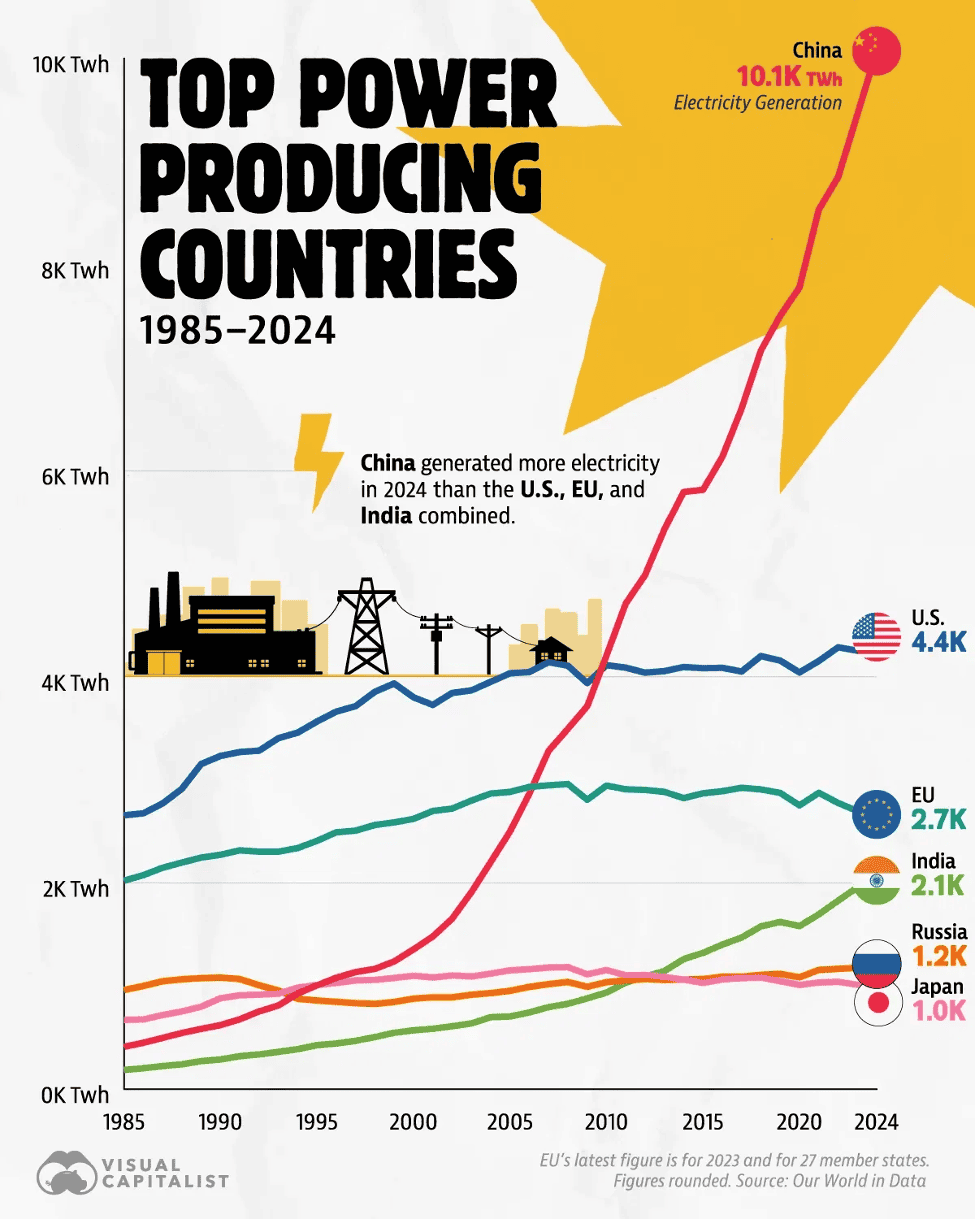
In a world dominated by AI, being outproduced in energy production by a geopolitical rival is simply unacceptable and a national security threat as electrical production is fundamental to AI. The threat is not just being able to run more AI machines but also with more energy there is more optionality in the types of computer chips that can be produced to power the AI. If countries like China have significantly more electricity supply, China will have more optionality on the types of hardware it can utilize in addition to being able to run more machines. As a result, the United States has a keen interest in ramping up energy production through whatever way possible whether that be natural gas, nuclear, solar, or any other means to close the gap with China.
Energy load refers to the amount of electricity demand placed on the power grid at a particular time. The demand for energy fluctuates throughout the day based on variables such as weather and the time of day. When energy demand is too high it can lead to a strain on the power grid which can lead to events such as blackouts or brownouts. These disruptions are widely understood to have significant economic costs through issues such as loss of productivity and damage to electric equipment. What is less well known is that too much energy in the system can be problematic. Situations where the supply of energy exceeds the demand can be extremely costly to energy companies as well. For example, United Kingdom consumers paid an astounding £215 million to turn off wind turbines in 2022 because the grid could not handle the amount of electricity the turbines were producing on the windiest days. That’s a gigantic waste of potential energy and money. Any alternative use of the excess energy that was bypassed by shutting down the wind turbines should be thoroughly explored to make these projects more efficient! Bitcoin miners offer a tool to monetize excess energy.
Bitcoin mining has several unique characteristics that could be leveraged to help the United States build up its energy production in an efficient manner. Furthermore, amendments to the current tax code could help incentivize bitcoin miners to operate in the United States and invest more resources in the underlying operations instead of paying taxes immediately. Before we explore these ideas, we will examine some unique characteristics bitcoin miners possess that other energy consumers do not.
The Unique, Malleable Characteristics of Successful Bitcoin Mining Operations
There are several characteristics of Bitcoin’s PoW protocol that could help the USA build out its energy grid as the country competes to win the AI race which will require immense energy consumption. To understand how Bitcoin’s PoW system could help the United States towards obtaining its AI energy needs it is important to understand nine characteristics of Bitcoin’s PoW system which are outlined in greater detail in an influential paper written by Ibanez and Freier titled Can Bitcoin Stop Climate Change? Proof of Work, Energy Consumption and Carbon Footprint. The following nine characteristics of bitcoin miners make it a unique business partner that should be integrated into every energy project in the United States.
Flexibility of Load
Bitcoin mining equipment can be turned on and off in under a second without the need to warm up or cool down. As a result, the equipment used to mine bitcoin can be turned on and off effortlessly depending on the supply of energy in the system.
Interruptibility
A bitcoin is mined approximately every 10 minutes. As discussed above, past solutions do not assist miners in mining a new block. Therefore, a miner is at no disadvantage in mining the next block even if it is turned on and off frequently!
Portability
The only two things that are needed for Bitcoin mining is an electricity source and a dependable internet connection. Additionally, the equipment necessary for Bitcoin miners to operate (ASIC machines and other mining equipment) can be transported easily. As a result, Bitcoin mining can theoretically occur anywhere on earth.
Cost and Price Sensitivity
The primary input to profitable Bitcoin mining is the electricity price powering the ASIC machines. Furthermore, the ASIC equipment has evolved as Bitcoin has matured. The newer ASIC machines can be profitable at a higher energy price. However, older ASIC machines are still viable options if the price used to power the ASIC machines is low enough. Importantly, Bitcoin miners are able to know the profitability points (measured by the cost of energy) for each ASIC miner with exact precision. As a result, Bitcoin miners can make prudent, efficient choices on which, if any, ASIC machines should be on at various times depending on the energy price.
Scalability
A unique feature of Bitcoin mining is a miner can enter the competition to mine the next block no matter how much energy it can access. An individual wishing to attempt to mine the next block may do so with CPU from an old laptop at home. On the other end of the scale, a renewable energy project wishing to use its excess energy can run as many ASIC miners as it can on the excess renewable energy being created. Any point between these two extremes is also feasible with Bitcoin mining. As a result, the Bitcoin mining industry can serve as a shock absorber for the energy grid and lead to more efficient energy consumption.
Consumption-Level Granularity
As a result of ASIC machines having different break even points given the rapid evolution of the equipment used to mine bitcoin, the energy consumption being utilized by Bitcoin miners can be adjusted up or down with extreme precision, with great efficiency, at no extra cost. In other words, a diverse mix of ASIC miners would allow for many different levels of energy consumption. This is a clear advantage to binary alternatives which feature an all or nothing approach to energy consumption.
Non-Rival Energy Consumption
If Bitcoin miners are properly integrated with renewable energy projects, the energy needed for the Bitcoin mining will not necessarily cause the need to generate more energy. Rather Bitcoin mining can help these renewable projects operate more efficiently and use energy that would otherwise be wasted. Beautifully, the ASIC machines will allow the renewable projects to make a profit through the mining of bitcoin on energy that would otherwise be wasted with no additional emissions being released in to the atmosphere.
Uncorrelated Revenue Streams
Bitcoin mining can be a beneficial and stable source of income for renewable energy projects because the fluctuation of bitcoin prices and electricity prices follow independent processes which are not correlated, providing the option to switch outputs when it is optimal.
Heat
The process of Bitcoin mining requires the input of energy. As a result of the law of conservation of energy (which states that energy cannot be destroyed rather it can only be transferred from one form of energy to a different form of energy), the energy used to mine the next Bitcoin block is largely transformed into heat. In the early days of mining cooling procedures were developed so the ASIC machines could continue to function. However, recently miners have been looking at ways to efficiently use the heat created through Bitcoin mining for everyday items such as heating homes, schools, commercial real estate, or water. If heat needs to be created for something, creating the heat with something functional such as Bitcoin mining is more efficient. This feature of Bitcoin mining will be used in the future to make a more energy efficient grid.
The nine characteristics listed above show how Bitcoin mining can be a unique partner for energy projects. Bitcoin miners can assist energy projects to become more efficient and resilient to load issues, prevent the need to flair methane gas and instead use the currently wasted methane gas to mine bitcoin which is not only more efficient economically but also massively reduces emissions, and creates a new revenue stream by accumulating bitcoin instead of letting the excess energy go unused. All energy projects could benefit from either partnering with Bitcoin mining companies or, alternatively, acquiring Bitcoin mining equipment and performing the mining themselves!
Other uses of the excess energy could also be utilized to stabilize the energy grid. However, all of these alternatives suffer from different shortfalls making the challenges of implementation less feasible if perfect parameters are not in place. Ibanez and Freier explore several alternative uses for excess power that renewable energies create such as water desalination, batteries, and flexible data centers, but conclude Bitcoin mining is most likely the best solution because of the flexibility discussed above. We highly encourage interested readers to review the findings of Ibanez and Freier in section VIII of their article. For this paper it is sufficient to say that we understand that there are other viable uses for the excess energy created by renewable energy projects so long as certain parameters are satisfied. However, none of these viable alternatives have the flexibility possessed by Bitcoin mining operations.
Bitcoin mining is unique because if there is excess energy in the system, additional Bitcoin mining equipment can be turned on to efficiently use the energy. Alternatively, if there is too much demand and more energy is needed, Bitcoin mining equipment can easily be turned off without any friction. The ease at which Bitcoin mining equipment can adjust to the demand for energy is extremely valuable.
The nine unique characteristics listed above make bitcoin miners a unique partner for every energy producer operating in the United States. It is critical the United States electricity sector continues to outpace the rapidly increasing demand that will be required to live in a more AI centric world. If the United States’ fails to keep up with the electricity demands of AI, a bottleneck will be created that will hamper the advances in AI. Therefore, any incentive that can be put in place to encourage electricity production must be explored. Bitcoin miners' ability to monetize, and as a result store excess energy within the electrical grid, is a tool the United States must encourage energy producers to leverage. Fixing the tax code will help incentivize this to occur.
Bitcoin Miners Should Be Taxed at Sale and Any Tax Should Be In-Kind
While some may view Senator Lummis’ bitcoin mining tax proposal as generous, in reality her proposal would treat bitcoin miners similarly to the way the tax code currently treats gold miners. In the United States, gold miners (including corporations, partnerships, or individuals operating mines) are not taxed immediately upon the extraction of new gold from the ground. Instead, the extracted gold is treated as inventory, and the costs associated with exploration, development, and production are either deducted currently (where permitted) or capitalized and recovered through cost of goods sold or depletion deductions. Taxation occurs when the gold is sold, at which point the sale generates gross income subject to federal income tax as ordinary business income for mining operations conducted as a trade or business.
The policy justification for delaying the taxation of gold until the point of sale, rather than imposing it at the time of extraction (mining), stems from a combination of administrative, economic, fiscal, and practical considerations in mining tax regimes. Similar parameters exist for the justification of delaying the taxation of bitcoin miners for bitcoin acquired through mining services. Additionally, and exponentially more important, bitcoin miners could serve as unique partners to energy producers which are vital to the United States winning the all-important AI race! Electricity producers must be encouraged to produce energy and favorable tax treatment of bitcoin mining can provide that incentive to capture all excess energy in the United States.
Regardless of when and if bitcoin miners are taxed, any taxed imposed on bitcoin miners should be an in-kind tax with all taxes collected from bitcoin miners being added to the United States Strategic Bitcoin Reserve. President Trump has been a champion for the bitcoin community during his second term in office and his crypto czar, David Sachs, clearly understands that bitcoin is unique to all other crypto projects. Instead of forcing miners to convert newly mined bitcoin into cash, miners should be allowed to pay their taxes in-kind and the United States government should add all of those taxes to the Strategic Bitcoin Reserve.
Under the current law, bitcoin miners are forced to convert bitcoin into United States dollars to pay any taxes owed. Examining the purchasing power of the US dollar and comparing it to the purchasing power of bitcoin shows the fallacy of this strategy. The graphic below shows just how much the United States dollar has lost in terms of purchasing power.
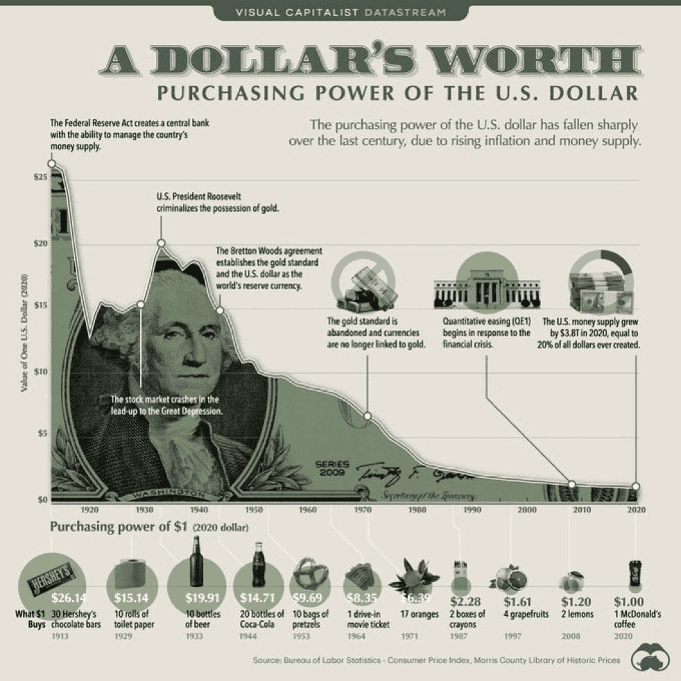
In fact, the strategy of converting United States dollars into bitcoin has been so successful for Michael Saylor at Strategy that many companies have started to mimic Strategy by accumulating as much bitcoin as possible. At the most basic level a company implementing this strategy is borrowing money denominated in fiat and purchasing bitcoin. The United States government when it is taxing bitcoin companies is forcing companies to convert bitcoin to cash. All available data says that is stupid.
To understand why this has been such a stupid tax strategy consider these two facts. First, one can say with almost 100 percent confidence that the value of a dollar today will be less in one year than that dollar is worth today due to the Federal Reserves stated two percent annual inflation goal. One thing the government has been able to reliably achieve is meeting its two percent inflation goal and in the years the government really wants to disadvantage its poorest citizens it has sometimes managed to double, triple, or even quadruple its inflation goal.
To the contrary, Bitcoin has a 16 year established history of appreciating in value at a staggering rate. One interesting way people view Bitcoin’s halving cycle is in terms of a clock. A halving occurs approximately every 4 years ((210,000 blocks 10 minutes)/(365.25 days 24 hours * 60 minutes) = 3.99 years). Viewing the halving cycles as a clock provides myriad interesting insights as the chart below illustrates.
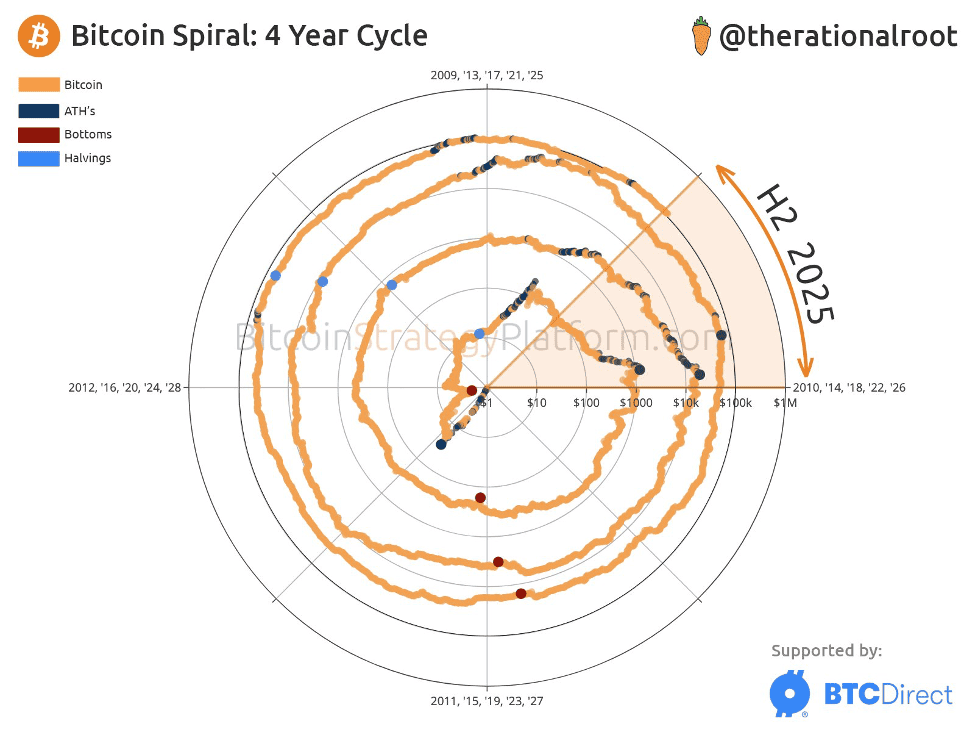
Arguably the most interesting and poignant insight the chart provides is the line representing the bitcoin price never intersects anywhere in the chart. In other words, the price of bitcoin has never been less at that specific point in the halving cycle compared to the previous halving cycle. The spiral has only grown outward. To the contrary, the dollar has fallen in value year after year during the same time frame. If there is any justification for taxing bitcoin miners, which one could argue there is not because of the importance of the energy build out, the tax must be paid in-kind and added to the United States strategic bitcoin reserve.
Conclusion
The United States must amend the tax code to delay the tax realization event for bitcoin miners to when the sale of the mined bitcoin occurs. This type of treatment is justified as it would treat bitcoin miners similar to gold miners. Additionally, any taxes paid by bitcoin miners should be paid in-kind and set aside for the strategic bitcoin reserve. These changes are justified to incentivize strategic partnerships between bitcoin miners and electricity producers to encourage more energy production and a more efficient grid.
In his speech at the 2025 Bitcoin Conference, JD Vance made it clear that the United States has begun to put in motion the strategic importance of Bitcoin for the future of the country. During Vance’s speech he pointed out, which he acknowledged was a gross overstatement, that very smart right-wing people in tech tend to be attracted to Bitcoin and crypto, and very smart left-leaning people in tech tend to be more attracted to AI. Vance encouraged bitcoiners to pay attention to what is happening in AI as it would affect in good and bad ways what happens to bitcoin. He also pointed out what happens in bitcoin is very much going to affect what happens in AI. Vance is correct and one way AI can benefit from bitcoin is through the use of bitcoin miners to incentivize the buildout of the electricity grid which will be absolutely vital to assuring the United States maintaining its position as the AI leader in the world while at the same time being the leading bitcoin country in the world. That’s a win win!